
Here are 10 of the most famous motivational speeches in history, including Martin Luther King Jr.’s “I have a Dream”, Winston Churchill’s, “We Shall Fight on the Beaches“, and Abraham Lincoln’s Gettysburg Address. Most of these inspirational speeches were delivered at pivotal moments in history. The speeches of UK Prime Minister Winston Churchill and Queen Elizabeth I were delivered in times of war, while the famous speeches made by Martin Luther King Jr. and Sojourner Truth were in defiance of the widespread disregard of African-American civil rights.
Marcus Tullius Cicero’s “Among Us You Can Dwell No Longer” speech was after the defeat of his opponent who attempted to overthrow his government in a coup d’état. William Faulkner’s famous speech was after winning the first Nobel Prize, and he dedicated his win to years of agony and sweat, and to all those hardworking men and women who would be awarded the prize after him.
Yet these inspirational speeches are powerful even to this day, and are great for anyone looking for the inspiration to achieve their dreams.
Famous motivational speeches: History’s most inspirational speeches
1. Martin Luther King Jr.: “I have a Dream” (August 28, 1963)
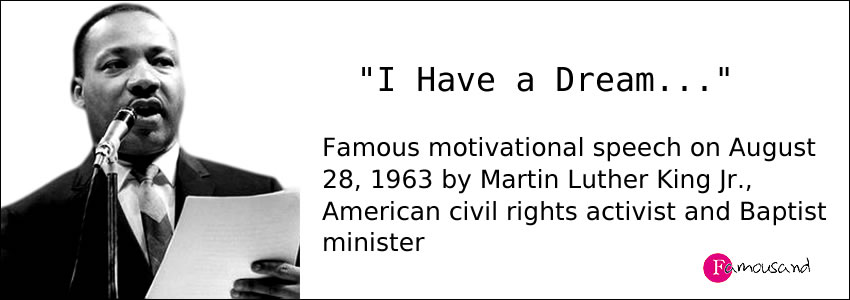
Delivered on August 28, 1963 at the Lincoln Memorial in Washington, D.C., Martin Luther King Jr.’s “I Have a Dream” speech called for racial equality, civil rights, and an end to discrimination, becoming a defining moment of the American civil rights movement.
Let us not wallow in the valley of despair.
I say to you today, my friends, so even though we face the difficulties of today and tomorrow, I
still have a dream. It is a dream deeply rooted in the American dream.I have a dream that one day this nation will rise up and live out the true meaning of its creed:
“We hold these truths to be self-evident: that all men are created equal.”I have a dream that one day on the red hills of Georgia the sons of former slaves and the sons of
former slave owners will be able to sit down together at the table of brotherhood.I have a dream that one day even the state of Mississippi, a state sweltering with the heat of
injustice, sweltering with the heat of oppression, will be transformed into an oasis of freedom
and justice.I have a dream that my four little children will one day live in a nation where they will not be
judged by the color of their skin but by the content of their character.I have a dream today.
I have a dream that one day, down in Alabama, with its vicious racists, with its governor having
his lips dripping with the words of interposition and nullification; one day right there in
Alabama, little black boys and black girls will be able to join hands with little white boys and
white girls as sisters and brothers.I have a dream today.
I have a dream that one day every valley shall be exalted, every hill and mountain shall be made
low, the rough places will be made plain, and the crooked places will be made straight, and the
glory of the Lord shall be revealed, and all flesh shall see it together.
2. Abraham Lincoln’s Gettysburg Address (November 19, 1863)
Abraham Lincoln, the 16th president of the United States, served from 1861 and was the U.S. president during the American Civil War that lasted from 1861 to 1865, the year of his assassination. He famously opposed slavery and played a major role in its abolition.
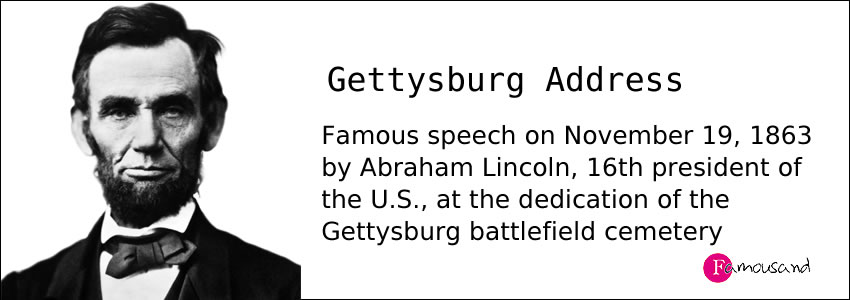
Abraham Lincoln’s famous “Gettysburg Address” was delivered at the dedication for the Gettysburg battlefield cemetery on November 19, 1863. The Gettysburg battlefield cemetery is the resting place for many soldiers who perished at the Battle of Gettysburg, the bloodiest battle of the Civil War and the turning point of the American Civil War.
Four score and seven years ago our fathers brought forth on this continent, a new nation, conceived in Liberty, and dedicated to the proposition that all men are created equal. Now we are engaged in a great civil war, testing whether that nation, or any nation so conceived and so dedicated, can long endure. We are met on a great battle field of that war. We have come to dedicate a portion of that field, as a final resting place for those who here gave their lives that that nation might live. It is altogether fitting and proper that we should do this.
Excerpt from the Gettysburg Address delivered at the dedication of the Cemetery at Gettysburg by Abraham Lincoln.
3. Sojourner Truth: “Ain’t I a Woman?” (1851)
Sojourner Truth, real name Isabella Bomefree, was an American abolitionist and activist who fought for African-American civil rights and women’s rights. She was also the first black woman to win a slavery case against a white man in 1828. Born into slavery, she later escaped with her daughter to freedom.
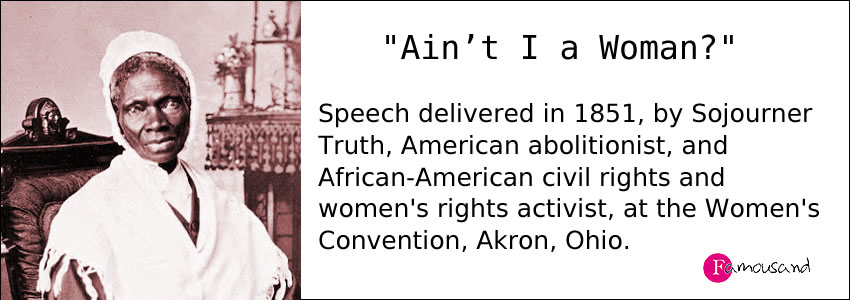
She delivered her famous speech in 1851 at the Women’s Convention, Akron, Ohio, U.S., highlighting her success despite being black and a woman.
She challenged the prevailing notions of gender and racial inequality, noting that some men believed that women couldn’t have as many rights as men.
That man over there says that women need to be helped into carriages, and lifted over ditches, and to have the best place everywhere. Nobody ever helps me into carriages, or over mud-puddles, or gives me any best place! And ain’t I a woman? Look at me! Look at my arm! I have ploughed and planted, and gathered into barns, and no man could head me! And ain’t I a woman? I could work as much and eat as much as a man – when I could get it – and bear the lash as well! And ain’t I a woman? I have borne thirteen children, and seen most all sold off to slavery, and when I cried out with my mother’s grief, none but Jesus heard me! And ain’t I a woman?
Then that little man in black there, he says women can’t have as much rights as men, ’cause Christ wasn’t a woman! Where did your Christ come from? Where did your Christ come from? From God and a woman! Man had nothing to do with Him.
If the first woman God ever made was strong enough to turn the world upside down all alone, these women together ought to be able to turn it back , and get it right side up again! And now they is asking to do it, the men better let them.
Excerpts from the famous motivational speech “Ain’t I a Woman?” by Sojourner Truth at the Women’s Convention, Akron, Ohio in 1851.
4. John Ball: “Cast off the Yoke of Bondage” (1381)
John Ball was an influential English priest, and a believer in the medieval religious movement of the Lollards that was active in England in the 14th century.
The Lollard priest delivered one of the most famous speeches, emphasizing on his belief that all men are created equal. His speech also dwelt on his belief that there was a need to change the then oppresive social hierarchy in which English peasants suffered social and economic injustices from the ruling class.
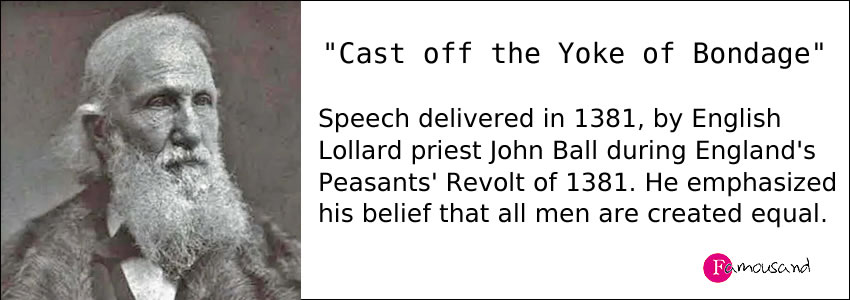
John Ball’s famous motivational speech urged the oppressed to “cast off the yoke of bondage, and recover liberty“, because he felt that the time was right. This was in the midst of England’s Peasants’ Revolt of 1381.
When Adam delved and Eve span, Who was then the gentleman? From the beginning all men by nature were created alike, and our bondage or servitude came in by the unjust oppression of naughty men. For if God would have had any bondmen from the beginning, he would have appointed who should be bond, and who free. And therefore I exhort you to consider that now the time is come, appointed to us by God, in which ye may ( if ye will ) cast off the yoke of bondage, and recover liberty.”
5. Winston Churchill: “We Shall Fight on the Beaches” (June 4, 1940)
Winston Churchill was the Prime Minister of the United Kingdom from 1940 to 1945. This was at the time of World War II, a global conflict that lasted from 1939 to 1945. He became the prime minister again after the October 1951 general election, serving from 1951 to his resignation in 1955 due to health issues.
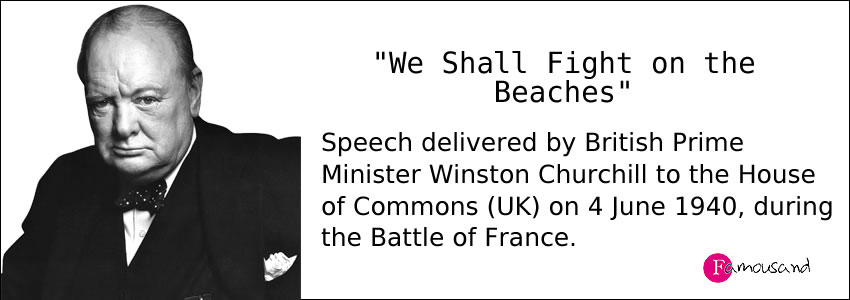
The famous “We Shall Fight on the Beaches” speech was delivered on June 4, 1940 in the House of Commons by one of the most famous people in history, UK Prime Minister Winston Churchill. Coming into office eight months after the start of World War II in Europe, Winston Churchill’s 1940 famous motivational speech emphasized his nation’s defiance and resolve to fight to the end, no matter what.
The British Empire and the French Republic, linked together in their cause and in their need, will defend to the death their native soil, aiding each other like good comrades to the utmost of their strength. Even though large tracts of Europe and many old and famous States have fallen or may fall into the grip of the Gestapo and all the odious apparatus of Nazi rule, we shall not flag or fail.
We shall go on to the end, we shall fight in France, we shall fight on the seas and oceans, we shall fight with growing confidence and growing strength in the air, we shall defend our Island, whatever the cost may be, we shall fight on the beaches, we shall fight on the landing grounds, we shall fight in the fields and in the streets, we shall fight in the hills; we shall never surrender, and even if, which I do not for a moment believe, this Island or a large part of it were subjugated and starving, then our Empire beyond the seas, armed and guarded by the British Fleet, would carry on the struggle, until, in God’s good time, the New World, with all its power and might, steps forth to the rescue and the liberation of the old.
6. William Faulkner: “The Agony and the Sweat” (December 10, 1950)
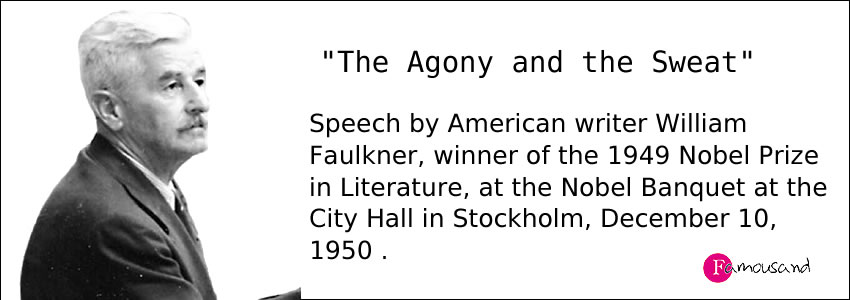
William Faulkner was an American writer who was awarded The Nobel Prize in Literature 1949. He is famous for writing novels and short stories, and his speech at the Nobel Banquet at the City Hall in Stockholm, December 10, 1950 is recognized as one of the most famous motivational speeches in history.
I feel that this award was not made to me as a man, but to my work – a life’s work in the agony and the sweat of the human spirit, not for glory and least of all for profit, but to create out of the materials of the human spirit something which did not exist before. So this award is only mine in trust. It will not be difficult to find a dedication for the money part of it commensurate with the purpose and significance of its origin. But I would like to do the same with the acclaim too, by using this moment as a pinnacle from which I might be listened to by the young men and women already dedicated to the same anguish and travail, among whom is already that one who will some day stand here where I am standing.
7. Emmeline Pankhurst: “The Plight of Women” (1908)
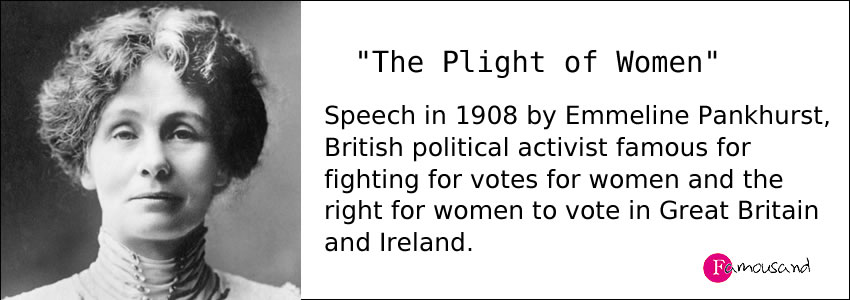
Emmeline Pankhurst, the British political activist famous for fighting for votes for women and the right for women to vote in Great Britain and Ireland, delivered one of the most famous motivational speeches in history.
This is the only way we can get that power which every citizen should have of deciding how the taxes she contributes to should be spent, and how the laws she has to obey should be made, and until we get that power we shall be here – we are here to-day, and we shall come here over and over again. You must realise how futile it is to settle this questions by binding us over to keep the peace. You have tried it; it has failed. Others have tried to do it, and have failed. If you had power to send us to prison, not for six months, but for six years, for 16 years, or for the whole of our lives, the Government must not think that they can stop this agitation. It will go on. …
Well, sir, that is all I have to say to you. We are here not because we are law-breakers; we are here in our efforts to become law-makers
8. Franklin Roosevelt: “The Only Thing We Have to Fear Is Fear Itself” (March 4, 1933)
Franklin D. Roosevelt (FDR) became the 32nd U.S. president in 1933, at the height of America’s Great Depression, a period marked by severe economic downturn, massive unemployment, widespread poverty and widespread bank failures. The Great Depression lasted from 1929 to the early 1940s.
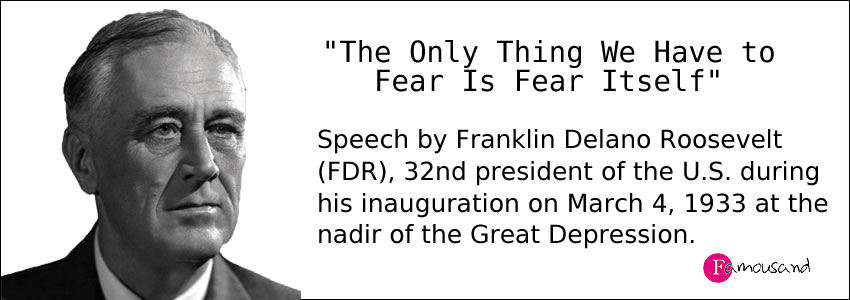
It is no wonder then, that one of the most famous motivational speeches was delivered at that time. This famous motivational speech was delivered on the East Portico of the U.S. Capitol at Washington D.C. by president Roosevelt during his first inaugural address on March 4, 1933.
This great Nation will endure as it has endured, will revive and will prosper. So, first of all, let me assert my firm belief that the only thing we have to fear is fear itself—nameless, unreasoning, unjustified terror which paralyzes needed efforts to convert retreat into advance. In every dark hour of our national life a leadership of frankness and vigor has met with that understanding and support of the people themselves which is essential to victory. I am convinced that you will again give that support to leadership in these critical days.
9. Marcus Tullius Cicero: “Among Us You Can Dwell No Longer” (63 BC)
Marcus Tullius Cicero was a Roman writer and statesman, and lawyer, scholar, philosopher and an orator who lived in the Roman Republic from 3 January 106 BC to 7 December 43 BC. The Roman Republic later became the Roman Empire in 27 BC. In one of the most famous motivational speeches and as one of Rome’s greatest orators, Marcus Tullius Cicero addressed the Roman Senate, in 63 BC, regarding the conspiracy of Catiline.
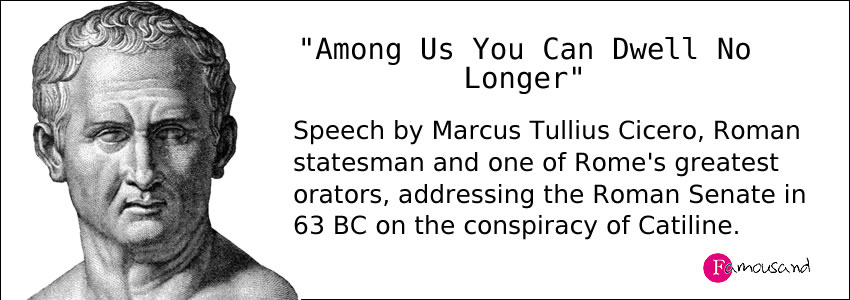
In the conspiracy of Catiline, Roman soldier and politician Lucius Sergius Catilina (Catiline) was defeated in consular elections. He then attempted a coup d’état to overthrow the then Roman consuls Marcus Tullius Cicero and Gaius Antonius Hybrida, in order to gain control of the state by force.
As, then, this is the case, O Catiline, continue as you have begun. Leave the city; at last the gates are open; depart. That Manlian camp of yours has been waiting too long for you as its general. And lead forth with you all your friends, or at least as many as you can; purge the city of your presence; you will deliver me from a great fear, when there is a wall between me and you. Among us you can dwell no longer—I will not bear it, I will not permit it, I will not tolerate it. Great thanks are due to the immortal gods, and to this very Jupiter Stator, in whose temple we are, the most ancient protector of thus city, that we have already so often escaped so foul, so horrible, and so deadly an enemy to the republic…
10. Queen Elizabeth I: “The Heart and Stomach of a King” (1588)
Elizabeth I’s reign is referred to as the Elizabethan era, and it is during her reign when one of the famous people born in April, famous English writer and poet William Shakespeare, flourished.
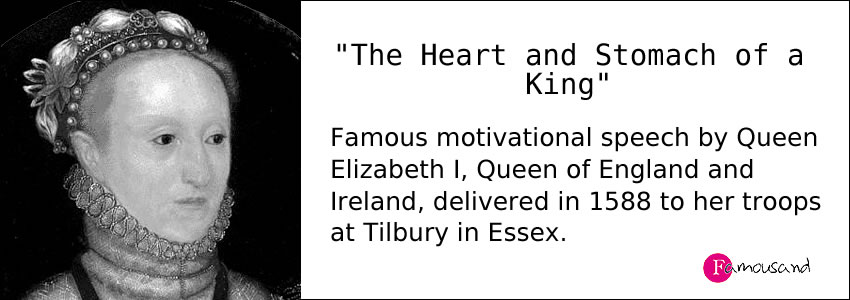
The Queen delivered one of the most famous motivational speeches to her troops at Tilbury in Essex, who were preparing to repel the Spanish Armada of a great fleet of ships that was an invasion force under the Duke of Parma.
As fate would have it, there was no invasion, as the invaders were defeated due to misfortune, miscalculation, and an attack of English fire ships.
I know I have the body but of a weak and feeble woman; but I have the heart and stomach of a king, and of a king of England too, and think foul scorn that Parma or Spain, or any prince of Europe, should dare to invade the borders of my realm; to which rather than any dishonour shall grow by me, I myself will take up arms, I myself will be your general, judge, and rewarder of every one of your virtues in the field. I know already, for your forwardness you have deserved rewards and crowns; and We do assure you in the word of a prince, they shall be duly paid you.